
edtech week 2025 resources
Couldn't make it to the festival, or looking to re-live the magic? Access recordings and view resources from select sessions at EDTECH WEEK 2025.

At this year’s festival, Chegg Skills hosted an invite-only Think Tank — “Rethinking Access: What Skilling Really Looks Like for Working Adults.” Leaders from Google, AWS, Coursera, Udemy, and WGU came together to tackle one big challenge in Workforce and Adult Learning: how do we design for the real learner, not the ideal one?
Learn more about Chegg Skills’ approach to skilling working adults:
Vision sets the tempo for transformation—and few visionaries have shaped the EdTech landscape more profoundly than Michael Moe. In this energizing opening keynote of the invite-only CEO Summit, Michael shares his latest outlook on the future of learning and work, drawing from decades at the intersection of capital, innovation, and social impact. From AI tailwinds to policy shocks, from global megatrends to startup signals, expect an insider’s roadmap of the forces reshaping education’s $7 trillion+ market.
For founders, acquirers, and investors, this is more than a forecast—it’s a challenge: to lead with purpose, to scale with clarity, and to build the platforms that define a generation.
-
Summary
The CEO Summit kickoff session serves as a purpose-driven "cathedral" for leaders who are actively scaling edtech businesses and inventing the future of education. Featuring opening remarks from Started's leadership, Alan Todd and Ash Kuarachchi, the session is anchored by a comprehensive keynote from Michael Moe of GSV. The presentation explores the rapid acceleration of technological change, the current crises in traditional education systems, and the essential skills and mindsets required to thrive in an AI-driven future.
Key Insights
1. The Accelerated Pace of Change and the Need for Lifelong Learning Technology has dramatically accelerated the pace of global change, shrinking the "half-life" of learned skills. In 1980, the half-life of a skill was 30 years; today, it is just five years, and for technical skills, it is merely two and a half years. Because of this, the traditional life model—learning until age 25, working until 65, and then retiring—is entirely obsolete. In the modern knowledge economy, individuals must learn continuously from birth until retirement.
2. A Crisis of Confidence in Traditional Higher Education Higher education is facing a severe product-market fit issue. While the cost of software and technology has plummeted, college tuition has increased by 185%, leading to $1.8 trillion in student debt. Consequently, 74% of Gen Z students are second-guessing traditional college, and confidence in higher education has fallen dramatically. Furthermore, 72% of employers now prioritize skills over diplomas, and 55% of employers eliminated degree requirements in 2023. Colleges are still largely designed for 18-to-22-year-olds, even though 73% of today's students are "non-traditional" learners who may have full-time jobs or children.
3. Systemic Failures in K-12 and the Rise of School Choice The traditional K-12 system is struggling, with 2023 seeing the lowest math scores in the history of the PISA test and massive proficiency deficits in major cities. A significant part of the problem is the misallocation of resources; over 50 cents of every dollar spent on education is consumed outside of the classroom where the actual service is rendered. The pandemic acted as a catalyst, giving parents visibility into these shortcomings and accelerating the school choice movement. Today, 36% of students are educated outside traditional public schools, with massive growth in charter schools, micro-schools, and homeschooling. Because school choice significantly improves outcomes for the most under-resourced students, it has become the "civil rights issue of our time".
4. AI and "Multiplication by Division" Artificial Intelligence is a ubiquitous "giga-trend" that acts like air—invisible but necessary to live. Rather than viewing AI as a threat, leaders should view it as a tool that eliminates friction and creates a massive "time dividend". The future is not "man versus machine," but rather "man and machine". By applying a concept called "multiplication by division," organizations can separate tasks based on what technology does best and what humans do best, resulting in hyper-driven productivity and innovation.
5. The Foundational Skills for the Future: The Seven C's + 2 Because technical skills expire so rapidly, foundational human skills are more critical than ever. The most vital attributes for future success are the "Seven C's": Critical thinking, Creativity, Communication, Cultural fluency, Civic engagement, Collaboration/teamwork, and Character. Among these, communication is the number one skill sought by employers. Additionally, students and professionals must master two more skills: "learning how to learn" and maintaining insatiable Curiosity.
Practical Tips
Optimize Your Networking Approach: When attending summits or professional gatherings, intentionally seek out people you wouldn't normally spend time with. In your first conversation, listen to the specific problem they are solving, evaluate if you genuinely care about it, and determine if you can help.
Prioritize Cultural Fluency: In an increasingly interconnected global marketplace, understanding how other cultures operate is not just polite—it is a business imperative. Ignorance of cultural norms can lead to painful professional misunderstandings and damaged relationships.
Design for Non-Traditional Learners: If you are building an edtech product or service, recognize that the "traditional" student is no longer the majority. Build solutions that cater to the 73% of learners who are balancing full-time jobs, parenting, and other adult responsibilities.
Automate to Elevate: Use AI to strip away friction and routine tasks in your workflows. Reinvest the time you save into uniquely human endeavors that machines cannot replicate, effectively combining "smarts and hearts".
Lead with Purpose and Love: While machines have chips, humans have hearts. The ultimate "silver bullet" for solving complex educational and societal problems is love—caring for your neighbors, society, and the next generation. Anchor your work in a deep "why" to create technology that truly changes the world for good.

What happens when the nation’s largest school system meets a leading changemaker at the intersection of AI, equity, and education?
In this conversation, former NYC Public Schools Chancellor Melissa Aviles-Ramos and activist-entrepreneur Colin Kaepernick discuss how AI can advance achievement and empower students. From improving reading instruction to amplifying student voice, the session explores both the promise and responsibility of serving nearly one million learners. They’ll examine how NYCPS is piloting AI, the vision behind Kaepernick’s platform Lumi, and how AI can support teachers and strengthen student identity.
-
Summary
This session brought together the leader of the nation’s largest school district and the founder of the AI-driven storytelling platform, Lumi, to discuss how Artificial Intelligence can serve as a catalyst for student empowerment rather than a replacement for traditional education.
Key Insights1. The Missed Opportunity of Post-COVID Education Chancellor Aviles-Ramos noted that while there are pockets of innovation, the U.S. largely missed the chance to systemically redesign schools after the pandemic. Most classrooms returned to students sitting in rows with teachers talking at them. The vision for an AI-powered future involves moving away from this model toward experiential learning where students demonstrate mastery through authentic community engagement rather than just paper tests.
2. AI as a Tool for Personalization and Agency A major theme of the discussion was using AI to meet students where they are.
Differentiation: Teachers often face classes with students ranging from 4th-grade to 11th-grade reading levels; AI can help personalize content to bridge these gaps.
Student Agency: Kaepernick emphasized that when students are given agency to drive the creative process, engagement skyrockets. He cited examples of students using AI to create narratives that processed deep personal trauma—such as bullying or the loss of a parent—while still meeting rigorous academic standards in English and Biology.
Real-time Intervention: Instead of waiting for lagging indicators like test scores, AI tools can assess literacy and surface intervention opportunities in real-time.
3. Empowering, Not Replacing, the Teacher Both speakers addressed the fear that AI will replace educators. The Chancellor argued that the deep, life-altering relationships teachers build with students cannot be automated. instead, the goal is to use AI to handle the "drudgery"—logistics, compliance, and grading—so teachers are freed up to focus on mentoring and instruction.
4. Equity, Access, and the "Digital Divide" The discussion framed AI as a potential "ultimate equalizer".
Resource Access: AI can provide high-quality tutoring and college advising to students whose parents cannot afford private services.
Language Justice: Kaepernick highlighted how AI tools allow students to create content in their native languages (e.g., Spanish, Japanese, Turkish) and translate it, ensuring that language barriers do not become knowledge barriers.
Cultural Responsiveness: NYC’s framework prioritizes tools that mitigate bias and celebrate diversity, ensuring content is culturally relevant to the student body.
5. The Risk of Inaction Perhaps the most urgent insight was that the biggest risk regarding AI is not the technology itself, but the failure to act. Kaepernick warned that we are facing a moment similar to the digital divide: communities will either close gaps exponentially or fall drastically behind. With 75% of employers already looking for AI skills, failing to prepare students for this reality is a disservice to their future.
Practical Tips
Based on the frameworks and experiences shared by Aviles-Ramos and Kaepernick, here are practical steps for implementing AI in schools:
For School Leaders and Administrators:
Implement a Safety Framework: NYC utilizes a four-part framework: 1) Ensure guardrails and data privacy, 2) Prepare students for AI careers, 3) Mitigate bias in tools, and 4) Support educators with administrative tasks.
Prioritize Visibility: When adopting new tools, ensure there is no "black box." Administrators and teachers should have visibility into the prompts and engagements students have with the AI to ensure safety and appropriateness.
Involve Stakeholders Early: Don't just hand down ed-tech mandates. Build with partners, teachers, and students to ensure the tools actually meet their specific needs.
For Teachers:
Shift to a Learning Mindset: You do not need to be an expert immediately. Adopt a growth mindset, experiment with the tools, and see what works for your specific classroom.
Leverage Student Passion: Use AI to allow students to connect curriculum to their personal interests. For example, explaining financial literacy concepts (like stocks) through the context of things they already care about (like sneakers).
Focus on Relationships: Use the time saved by AI tools to double down on the human element—mentoring and emotional support—which technology cannot replicate.
For Ed-Tech Entrepreneurs:
Solve for the Whole District: Don't just focus on a niche outcome. successful tools must account for the needs of students, teachers, administrators, and parents simultaneously.
Make it "Loveable": It is not enough to meet state standards; the tool must be engaging. If students don't like using it, they won't learn from it.
As teachers and learners bypass traditional platforms to use AI directly, this session explores what—and who—still matters in education. Foundation models like ChatGPT are rapidly becoming primary learning tools, with students choosing free, always-on, personalized AI over institutionally procured EdTech. While districts invest billions in complex platforms, learners are driving adoption from the bottom up. We’ll examine the data behind this shift, the economics of AI-first disruption, why legacy moats like content and LMS integrations are eroding, and how power is moving from institutions to learners—reshaping product design, pricing, and the future of learning.
-
Summary
The central premise of the session is that we are witnessing the "disintermediation of education" rather than just EdTech. Students are bypassing traditional tutors, teachers, and specific EdTech applications in favor of going directly to Foundation Models (like ChatGPT, Claude, or Gemini) to support their learning.
1. The Shift to Direct-to-Consumer AI Data suggests that over 50% of students globally (and up to 87% in the US) are using foundation models for schoolwork. Students prefer these models because they are accessible, hyper-personalized, free, and, perhaps most importantly, non-judgmental. Unlike a teacher, a chatbot does not judge a student for asking "stupid" questions, creating a safe, autonomous space for inquiry.
2. The New Competitive Moat: Data & Orchestration The old value proposition of EdTech—"high-quality content curation"—is evaporating because AI commoditizes content creation. The new competitive advantage ("moat") lies in two areas:
Longitudinal Data: Owning the history of what a student understands over time to provide meaningful personalization.
The "Last Mile": While general AI platforms are powerful, there is still a need for vertical-specific solutions that handle policy, safety, physical school integration, and complex pedagogy.
3. The Tension Between "Education" and "Learning" A critical distinction was drawn between education (the systems, institutions, and compliance required to "raise the floor" of testing standards) and learning (the natural, boundless curiosity to "raise the ceiling" of a child's potential).
Parents are increasingly focused on learning and maximizing their child's specific potential, often feeling that schools are too focused on minimum proficiency.
Schools are struggling to keep up with the personalization AI offers, leading to a potential fragmentation where parents seek "a la carte" educational solutions outside the system.
4. Big Tech Strategies vs. The EdTech Opportunity
Google is pursuing an "AI Everywhere" B2B strategy, infusing AI into existing classroom workflows to keep users in their ecosystem.
OpenAI is pursuing a direct-to-consumer strategy, bypassing institutions to go straight to learners.
The EdTech Opportunity: Builders should leverage open-source infrastructure rather than building from scratch. By treating open-source tech as a platform, companies can focus on the specific application layer, effectively starting the race "two miles ahead".
Key InsightsThe "Agency Model": We are moving from a dependency model (waiting for experts to build tools) to an agency model where parents and kids use the same general-purpose AI tools at the kitchen table to solve problems.
The Human Advantage: As AI becomes better at personalization and content delivery, the unique value of schools and teachers shifts to the human element—social connectivity, safety, emotional support, and purpose.
The "Low-Tech" Counter-Trend: Amidst the AI boom, there is a rising demand for "low to no tech" environments for younger children, evidenced by a 40% growth in physical book sales for some companies.
Infrastructure over Apps: There is a massive need for better underlying infrastructure (machine-readable state standards, learning progression maps) to replace rigid, legacy data schemas.
Practical TipsFor EdTech Builders & Founders:
Focus on Outcomes, Not Tech: Stop asking "What can I do with AI?" and start asking "What outcomes are we trying to achieve?" Use AI to accelerate those specific goals.
Don't Build the Foundation: Use existing infrastructure (like open-source models or CZI’s open learning standards) to lower engineering costs. You can now build a $10 million company with a very small team by focusing on a specific use case.
Solve for Safety: General AI models have blurred lines (e.g., students forming parasocial relationships with chatbots). Building tools that ensure safety and appropriate pedagogical boundaries is a vital value-add.
For Legacy Companies:
Leverage Distribution: Your biggest advantage is your existing distribution network and customer relationships. If you integrate AI quickly and flexibly, you can outperform new AI-native startups that lack access to schools.
Be Flexible: Do not try to protect your old business model. Be willing to pivot direction based on how the models evolve, rather than fearing that the next GPT update will kill your product.
For Educators & Schools:
Double Down on Humanity: Do not try to out-personalize the AI. Focus on being the primary provider of safety, social development, and human guidance.
Embrace "Old School" Joy: Remember that sometimes the best engagement is non-digital, such as a child laughing at a physical math comic book.
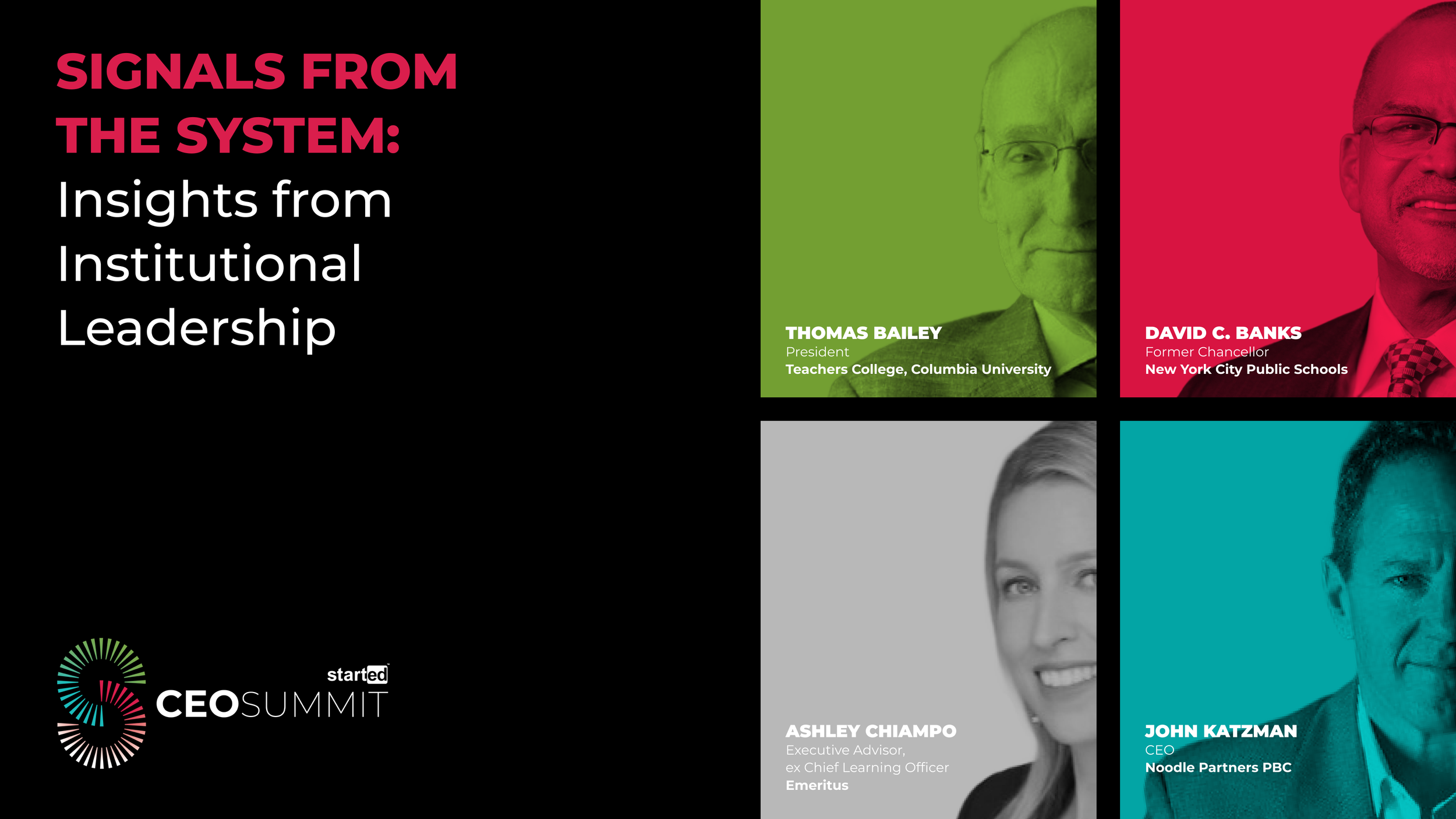
What signals do institutions send when they’re ready to adopt innovation—and how can EdTech leaders listen better? In this rare dialogue, a room of the most influential voices in education leadership share how they evaluate new ideas, balance innovation with accountability, and choose partners that align with system-wide priorities.
From district-scale decision-making to postsecondary transformation, this session reveals how leadership teams weigh risk, evidence, and equity—and what innovators need to understand to build meaningful, durable relationships.
-
Summary
The "Missing Link" in Lifelong Learning The session opened with a stark realization: while the lifelong learning market is valued at approximately $100 billion and growing, higher education institutions hold only about a 1% market share. This is despite universities possessing trusted brands, deep content expertise, and superior pedagogical skills compared to many alternative credential providers. The panel framed this as a massive missed opportunity for higher education to expand its reach and impact.
Breaking the Isolation Between K-12 and Higher Ed A central theme was the historical "isolation" between university schools of education and the K-12 districts they serve.
The Alignment Mandate: David Banks highlighted that school systems can no longer afford to hire teachers unprepared for district-wide strategies. He cited the "NYC Reads" initiative, noting that he informed higher education leaders that if they did not teach the "science of reading," the city would simply not hire their graduates.
System vs. Collection of Schools: Banks argued that to move from having "great schools" to being a "system of great schools," districts must connect the dots between higher ed partners, community organizations, and parents, ensuring a standardized, high-quality approach across the board.
The AI Revolution: Assessment, Feedback, and Roles The panelists agreed that AI is not just a tool for efficiency, but a mechanism to fundamentally change learning outcomes.
The Death of the Traditional Essay: Tom Bailey noted that AI challenges 200-year-old assessment methods like the essay. If an AI can write the report, educators must pivot to teaching and assessing the underlying thinking and research processes rather than the final written product.
Immediate Feedback: Ashley Campo emphasized that AI allows for "instant feedback and practice" at scale—something previously impossible. This allows students to go through the learning cycle multiple times in a single sitting rather than waiting weeks for a professor's grade.
Solving the Personnel Gap: Banks pointed out that AI offers a solution to the chronic shortage of guidance and career counselors in K-12 schools. AI can democratize access to college and career advice for students who currently receive little to no support.
The Enduring Value of Liberal Arts Despite the push for technical skills, the panel defended the long-term economic and social value of a liberal arts education.
Adaptability Over Obsolescence: Bailey warned against the "coding bootcamp" mentality, noting that specific technical skills (like coding) can become obsolete quickly. In contrast, liberal arts education fosters adaptability and social interaction—skills necessary to survive in a world where technology changes every five years.
AI Literacy as a Liberal Art: Banks added that even liberal arts majors must embrace AI. Success in the future workforce will depend on the critical thinking required to "prompt" AI effectively.
Practical TipsBased on the insights shared by the panelists, here are actionable takeaways for stakeholders in the education ecosystem:
For EdTech Companies
Target the "Counseling Desert": There is a massive, specific opportunity to build AI tools that function as college and career counselors for K-12 students, filling a gap that human staffing cannot currently meet.
Focus on Authentic Assessment: Move beyond digitizing multiple-choice exams. Build systems that ingest homework, quizzes, and writing samples to provide a holistic, real-time picture of student progress.
Support the "Edges" of the Classroom: Design AI specifically to help teachers manage the diverse range of learners—providing enrichment for accelerated students and remediation for those struggling—so the teacher isn't forced to only teach to the middle.
For Higher Education Leaders
Align with District "Customers": Do not develop teacher preparation curricula in a vacuum. Actively partner with local school districts to ensure your graduates are trained in the specific pedagogies (e.g., science of reading) the districts are implementing.
Re-evaluate Learning Outcomes: Audit your syllabus. If an assignment can be easily completed by ChatGPT, ask what learning outcome you are actually trying to measure (e.g., critical thinking, research). Redesign the assessment to measure the process, not just the output.
Teach "Durable" Skills: In an era of rapid technological obsolescence, double down on teaching adaptability, collaboration, and complex problem-solving. These are the skills that prevent graduates from becoming obsolete.
For K-12 Leadership
Shift the Teacher's Role: Encourage a shift where teachers become "orchestrators" of social learning and collaboration, while leveraging AI for rote skill-building and immediate feedback.
Prioritize Mental Health: As AI and screens become more prevalent, remain vigilant about the "isolation" effect. Ensure schools remain places of social connection and community building, potentially by limiting phone use or emphasizing team-based work.

In this session, Google’s first Chief Education Evangelist, Maven’s VP of Product, and the founder of Learning By Design share the real-world playbook they used to disrupt crowded markets. Attendees will learn practical, non-obvious strategies for surviving and scaling, including how to define a differentiated value proposition that wins by solving real user problems, how to choose between bottoms-up word of mouth and top-down sales models, and how to identify and rapidly validate core product assumptions from 0→1 and beyond. Designed for founders and CEOs ready to build movements, not just products.
-
Summary
This session featured David (Learning by Design), Rishan (Teachers Pay Teachers, Maven), and Jaime Casap (former Google Education Evangelist) discussing the lifecycle of EdTech companies. The conversation spanned three distinct phases: the "zero to one" early stage, the growth stage (specifically regarding marketplaces), and the scaling stage involving institutional sales. The overarching theme was that successful EdTech is not driven solely by code or technology, but by human relationships, authentic storytelling, and the ability to solve specific, immediate problems for users before attempting to change the entire educational system.
Key InsightsThe "Human" Moat: In an era where AI can speed up coding and product creation, your primary differentiator is no longer just your technology. It is your personal vision, your network, and your authentic story.
"Lowercase p" Problems: Founders often try to solve massive, systemic issues ("capital P" problems) too early. Success comes from solving a specific, smaller pain point ("lowercase p") for a specific person. Traction creates the clarity needed to tackle the bigger mission later.
Trojan Horse Strategy: Building a strong B2C (Business to Consumer) base—getting individual teachers or learners to love your product—is often the most effective way to break into B2B (Business to Business) institutional sales.
The Power of Narrative: Decision-makers (like school districts) are moved by relatable stories of pain and solution, not by feature lists or raw statistics.
Practical TipsDo Things That Don’t Scale: In the early days, offer services, training, or consulting to generate revenue and learn about your customers manually. You don't need a fully polished software product to start solving problems.
Build in Public: Use platforms like LinkedIn to share your expertise and journey. This attracts both your initial customers and, in the case of marketplaces, your supply side (content creators/teachers).
Create a "Ladder of Value": Give away something valuable for free (like a "lightning lesson" or free resource) to build the trust necessary to eventually sell paid products.
Sell the Roadmap: When selling to schools, be transparent that they are buying a partnership, not just a tool. If the product isn't perfect, show them where it is going and invite them to help shape it.
Leverage Constraints: If you have a small team, partner with larger organizations (like state tech associations) to get in front of hundreds of decision-makers at once, rather than trying to visit every school individually.
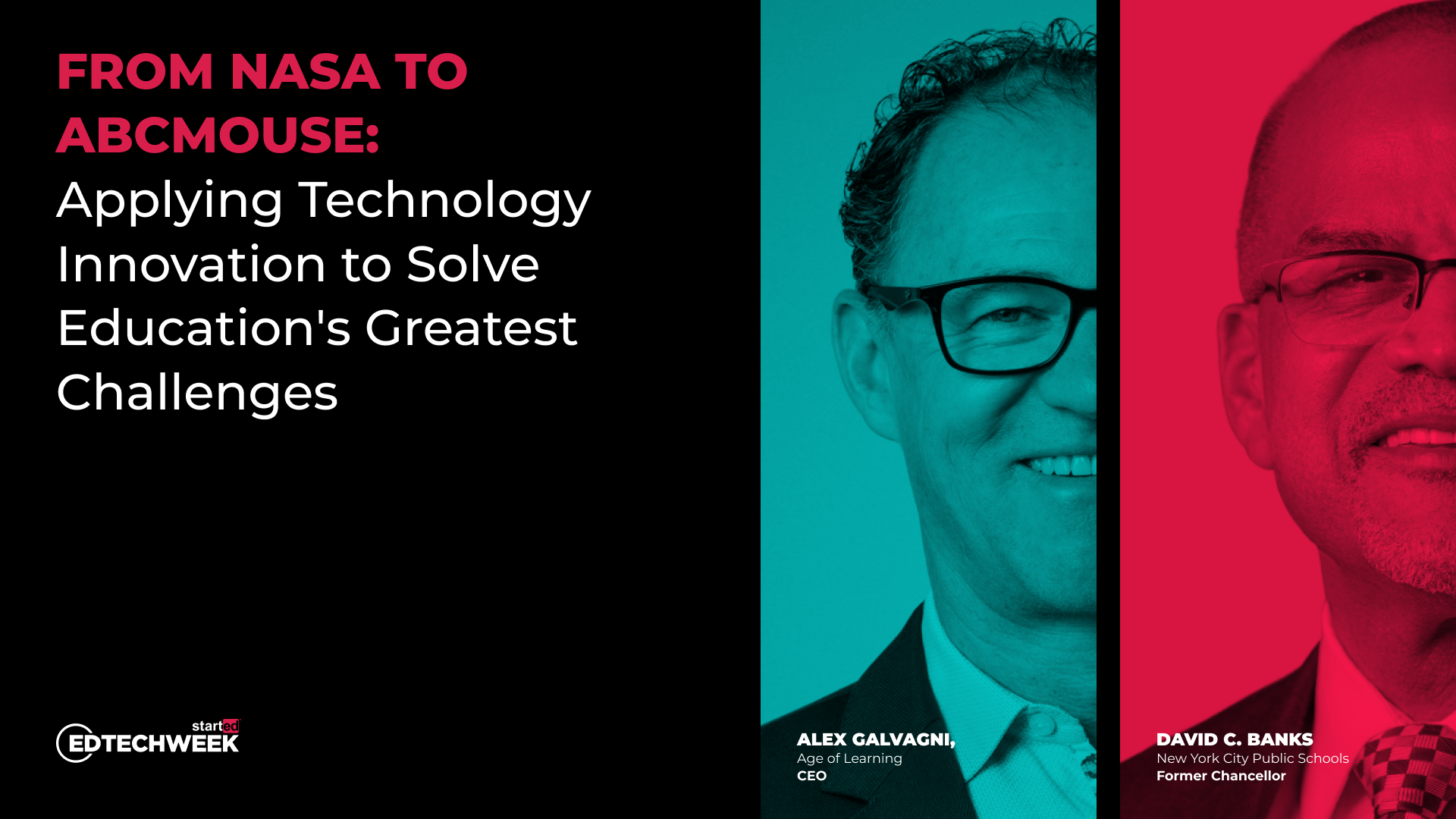
What happens when a NASA-trained technologist takes on education’s biggest problems?
This is a rare look inside the speaker's journey from building AI systems at NASA to leading the team behind ABCmouse and other groundbreaking learning platforms. In this fireside chat, Galvagni will share how his background in advanced technology is shaping scalable, effective, and engaging solutions that meet learners where they are—and move them forward.
This session offers powerful lessons on how cutting-edge innovation, when rooted in educational purpose, can transform learning outcomes at scale.
-
Summary
This session featured a conversation between David C. Banks, former Chancellor of New York City Public Schools, and Alex Galvani, CEO of Age of Learning (creators of ABCmouse). The discussion explored how Galvani’s background in NASA robotics and mobile gaming informs his approach to EdTech. The central theme was leveraging Artificial Intelligence (AI) not to replace educators, but to scale personalized learning, close equity gaps, and foster a lifelong love of learning.
Key Insights1. AI as a Guide, Not a Chatbot While many companies are rushing to create chatbots, Age of Learning utilizes Large Language Models (LLMs) to create a "Mastery AI Assistant".
Personalized Pacing: Instead of a static curriculum, the AI identifies exactly where a child is struggling and provides specific content to keep them in their "zone of proximal development".
Safety and Efficacy: Galvani emphasized that their tools are not chatbots that might hallucinate. Instead, the AI guides students through vetted activities, ensuring accuracy while adapting to the student's pace.
2. The Power of Gamification Galvani drew upon his experience in the mobile gaming industry to highlight that engagement is the prerequisite for learning.
High Engagement: Children using these tools often feel like they are playing a game rather than studying, which leads to significantly higher usage rates compared to standard EdTech software.
Non-Punitive Design: A core "guardrail" for the company is ensuring content is never punitive. Children do not lose points or face negative consequences for mistakes, which preserves their confidence and enjoyment.
3. Innovation promoting Equity and Access Technology is being used to expand reach rather than restrict it to wealthy families.
Global and Local Access: Through AI-driven voiceovers and translations, ABCmouse is now reaching children in countries like Pakistan and Peru. Domestically, the product is free in over 100,000 classrooms and public libraries.
Freemium Models: A new version of ABCmouse includes a "basic mode" that is completely free for families who cannot afford a subscription, ensuring financial barriers do not prevent access to foundational learning.
4. Superpowering Teachers The speakers addressed the fear that AI might replace educators. Galvani argued that AI increases productivity rather than eliminating roles.
Differentiation: One of a teacher's hardest tasks is managing a classroom of students with vastly different skill levels. The software handles this personalization automatically.
Offline Support: The system can generate offline lesson plans specific to a student’s needs, giving teachers actionable tools to use away from the screen.
Practical TipsFor EdTech Leaders and Developers
Obsess Over the Mission: Successful organizations obsess over their core goal—whether it is customer service (Amazon) or information (Google). For education companies, the obsession must be on "reach and impact".
Build Diverse Teams: Drawing on his NASA experience, Galvani recommends building teams that value diversity of thought, including a mix of PhDs and self-taught programmers, within a flat meritocracy.
Iterate Constantly: Just as NASA constantly improved space shuttle docking solutions, EdTech requires a mentality of constant iteration to improve safety and efficacy.
For Educators and Administrators
Embrace AI for Productivity: View AI as a tool to handle time-consuming tasks like differentiation and lesson planning, allowing you to focus on direct instruction and student relationships.
Focus on Early Foundations: Literacy and a love of learning must be established early (ages 2–8). Interventions at this stage are critical for long-term academic success.
For Parents and Communities
Broaden Career Exposure: Children "will be what they see." Use digital resources to expose children to careers they might not see in their immediate neighborhood. Age of Learning partners with NASA and the MLB to connect math and science to space exploration and baseball.
Look for "Bright Starts": Ensure children have a solid foundation before third grade. Using engaging, non-punitive educational games can help children develop intrinsic motivation and a love for learning.

For many K–12 providers, this has been the toughest sales year since the Great Recession. Slowed cycles, shifting priorities, and tighter district budgets have left even seasoned teams wondering: Is it just us, or is the whole market changing?
This session convenes district and EdTech leaders, grounded in fresh proprietary data from Tyton Partners, to unpack the systemic pressures shaping today’s K–12 buying environment. We’ll examine how purchasing decisions are evolving, which pain points matter most to administrators, and what strategies are helping providers navigate the turbulence.
Now is the time to reset K–12 strategy for 2026 today.
-
Summary
The panel, moderated by Adam Newman with insights from Sil Ganderia, Juliana Finnegan, and Graham Foreman, reached a consensus that the current K-12 selling environment is exceptionally difficult.
The Current Landscape: "Clouds" and Headwinds The market is facing a "post-ESSER cliff" where federal funding is drying up. Simultaneously, schools are dealing with structural pressures like declining enrollment and the rise of school choice programs (ESAs) that divert funds away from public districts.
Market Saturation: The average district now has roughly 2,800 different products in use, leading to massive buyer fatigue.
The Bell Curve: The market is splitting; roughly half of companies are contracting, while the other half are growing based on execution and focus.
Consolidation: When budgets tighten, districts cut programs before they cut teachers. There is less willingness to experiment with multiple vendors.
Reasons for Optimism: The "Sunshine" Despite the challenges, the panel argued this is actually the best time to start an edtech company. Unlike a decade ago, infrastructure is no longer a barrier: 99% of schools have broadband, and 1:1 device ratios are standard. Furthermore, AI represents a massive wave of opportunity for innovation.
Key Insights1. The "Lighthouse" Strategy In a saturated market, social proof is everything. Districts want to know who their neighbors are using.
Focus on Hubs: Secure a "lighthouse district"—a respected district in a specific region.
Leverage Networks: Use that district to influence neighboring districts or regional consortiums. If you don't know who the "lighthouse" leaders are, look at state association boards.
Lunch and Learns: Instead of a sales pitch, have your lighthouse customer host a lunch where they tell the story of how the product works for them. Let the teachers and leaders be your spokespeople.
2. Co-Creation and Community Successful founders are moving away from "building then selling" to "co-designing."
Early Validation: Build the product alongside the user to ensure it solves an acute pain point.
User Councils: Create advisory boards or councils (like Vivy’s educator council) to turn users into evangelists. This creates a community where educators help each other use the tool, reducing the burden on your support team and increasing stickiness.
3. Evidence Over Influence While "influencer teachers" on social media compete for attention, districts need evidence of effectiveness.
Differentiation: In a market with thousands of tools, having third-party validation or rigorous studies (like ESSA-aligned evidence) is a key differentiator.
Strategic Piloting: Run pilots specifically designed to gather data (pre- and post-assessments) that prove your specific value proposition, as seen with the Age of Learning example in Florida.
Practical TipsDo’s and Don’ts of Outreach
STOP Batch Emailing: Generic "spray and pray" emails are ignored. Decision-makers receive 30-40 calls/emails a day and answer almost none of them.
DO Your Homework: Before reaching out, know the district’s strategic plan, their community demographics, and their specific challenges.
Focus on the Underserved: Don't just chase the biggest districts (NYC, Chicago). Look at rural districts, charter schools, or private schools where decision-making is faster and bureaucracy is lighter.
Hiring and Team Building
Don’t Hire Sales Too Early: Founders must make the first batch of sales to establish a track record. A hired salesperson cannot sell a "vision" as well as a founder can.
Beware the "Big Publisher" Rep: Hiring a sales lead from a massive textbook publisher is often a mistake for startups. The skill set required to go from "zero to one" is completely different than managing an existing book of business.
Hire Former Educators: Look for team members who can translate your product’s value into the language of the school ecosystem.
Sales KPIs and Data
Meetings-to-Sale Ratio: A healthy metric for early-stage companies selling to districts is 8 to 12 meetings to close a single sale.
The "Budget" Bluff: When a prospect says they don't have the budget, ask: "If you did have the budget, is there any other reason you wouldn't move ahead?" This often reveals the real objection (e.g., lack of buy-in, wrong features).
Track "Closed/Lost": Don't just track wins. Rigorously analyze why you lost deals to understand where your product or process is breaking down.

As AI weaves deeper into classrooms and children’s lives, trust is on the line. Parents and educators are sounding the alarm over data use, personalization, and screen time—and the pace of innovation is outstripping their ability to keep up.
In this timely session, we’ll unpack what it really takes for EdTech and ChildTech companies to build (and maintain) trust in the AI era. From privacy and security to transparency and ethical design, we’ll explore the must-haves for any company working with kids and classrooms.
-
Summary
This session brought together leaders from the EdTech and privacy sectors to discuss the urgent challenge of integrating AI into education while preserving safety, trust, and privacy. Moderated by Daphne Li (Common Sense Privacy), the panel featured Eilert Hanoa (CEO, Kahoot!), Adil Khan (CEO, Magic School), and Aaron Cuny (CEO, AI for Equity). The discussion focused on "privacy by design," the operational challenges schools face in vetting new tools, and the ethical responsibilities of companies to prevent addiction and ensure meaningful learning outcomes.
Key Insights1. Privacy Must Be "By Design," Not an Afterthought Both Kahoot! and Magic School emphasized that privacy is a foundational principle, not a feature to be added later.
Fundamental Alignment: Companies must align their business models with their users' best interests. For example, Kahoot! does not collect personal data from students because their model relies on subscriptions, not selling data.
The Trust Layer: Privacy should be viewed as a "trust layer" rather than mere compliance. When products are designed with the assumption that they must be safe for children globally (complying with GDPR, COPPA, FERPA), it simplifies decision-making during product development.
2. The Value of "Intentional Friction" Contrary to standard tech philosophy which seeks to remove all friction, responsible EdTech may need to add it back in.
Safety Pauses: Magic School builds "intentional friction" into their platform, such as warnings and acknowledgments when a teacher is about to use a tool that might inadvertently invite the sharing of student data. This reminds users to mask Personally Identifiable Information (PII).
Building Trust: Surprisingly, adding these friction points did not reduce user retention. Instead, it signaled to school administrators that the platform was responsible and safe, leading to higher adoption rates in districts that usually ban AI tools.
3. The Operational Crisis for Schools School systems are struggling to keep up with the pace of AI innovation.
The Vetting Bottleneck: There is a tension between "frontline innovation" (teachers wanting to use new tools immediately) and the limited capacity of IT departments to vet those tools.
Moving Targets: Software evolves so rapidly that a tool vetted today might change its terms or functionality (e.g., version 1.0 to 1.2) within a month, rendering the previous approval obsolete.
Lack of a Yardstick: Without a single, agreed-upon standard for privacy beyond basic laws like FERPA, districts are forced to triangulate conflicting validations from different sources.
4. Combatting the "Slop" and Addiction The panelists warned against the dangers of AI generating infinite low-quality content ("slop") and addictive loops.
Engagement vs. Outcomes: There is a critical distinction between tools optimized for "engagement" (keeping eyes on screens) and those optimized for "learning outcomes." Responsible tools should encourage breaks and human-to-human interaction rather than dependency.
Digital Literacy: We are at risk of relegating students to a life of "staring at their phones" if schools do not actively teach technology literacy and responsible usage alongside academic subjects.
5. Emerging Risks
Unstructured Data: The rise of chatbots means vast amounts of unstructured data are being collected. This increases the risk of PII slipping through and requires better masking solutions.
"Vendors of Vendors": Schools need to worry not just about the primary software they purchase, but the third-party vendors that software relies on, creating a complex chain of data custody that is hard to verify.
Practical TipsFor EdTech Companies
Implement Data Masking: Automatically mask student PII in inputs and outputs to protect users who may not be privacy experts.
Build for "Whole Humans": Design features that prevent addiction. For instance, Magic School flags students to "take a break" if they have been messaging a bot for too long, mitigating the risk of forming parasocial relationships with AI.
Transparency for Admins: Treat school administrators with the same respect as end-users by giving them clear controls and transparency over how AI features function and what data is processed.
For School Leaders and Educators
Leverage Third-Party Validation: Due to limited internal capacity, lean on trusted third-party validators (like Common Sense Privacy) to handle the ongoing vetting of vendors.
Check "Out of the Box" Settings: When adopting new tech, ensure the default settings are the most privacy-preserving. Do not rely on teachers to manually configure safety settings; the tool should be safe by default.
Teach Responsible Use: Move beyond banning AI. Teach students (and staff) that "great education" includes knowing how to use technology without becoming addicted to it.
For Parents and the Community
Look for Learning Outcomes: When evaluating tools for your children, ask if the software is designed to help them learn or just designed to keep them clicking. High engagement metrics do not always equal high educational value.
Value Niche Expertise: Be aware that massive generalist AI platforms (like ChatGPT) may not have the specific privacy guardrails required for K-12 education. Vertical, education-specific tools are often safer and more pedagogically sound.

AI is transforming education—but not always for the better. As new tools flood classrooms, risks of distraction, misuse, and inequity grow. In this conversation, a leading education journalist joins two learning scientists to examine the biggest mistakes we’re making with AI in schools—and how to correct course.
You’ll hear how overhyped solutions can undermine pedagogy, how AI systems can reinforce bias, and why student safety and learning outcomes must come before flashy features. This session outlines what responsible AI adoption looks like—grounded in research and anchored in sound teaching practice.
-
Summary
This panel explored the intersection of learning science—defined as the study of how students organize, comprehend, and apply information in real-world contexts—and the rapid rise of generative AI. The discussion moved beyond simple "cheating" concerns to address deeper structural shifts: the displacement of human relationships, the necessity of "cognitive struggle" for learning, and the need for EdTech to solve actual classroom problems rather than adding complexity.
Key Insights1. The "Relationship" Paradox A central tension identified is that AI may disrupt the human connections essential for learning. Julia Freeland Fisher warned that as consumer AI tools become better at emulating empathy and connection, students are increasingly forming "companion-like relationships" with bots.
The Risk: AI is becoming better at "human skills" (like motivational interviewing and empathy) than overtaxed human advisors. This creates a risk of long-term isolation where students trade quality human interaction for the convenience of AI.
The Context: Relationships are the "operating system" inside of which learning happens; if schools do not prioritize this, AI will fill the void.
2. Cognitive Offloading vs. The "Hard Part" of Learning A major pitfall of AI is "cognitive offloading"—using tools to skip the mental effort required to create new neural pathways.
The Science: Learning requires synapses to fire; if AI summarizes everything or writes the essay, the student skips the "hard part" essential for retention.
The Nuance: Sean Francis argued against simply making learning "hard," suggesting the goal should be "appropriately challenging" within a student's zone of proximal development.
3. The Assessment Crisis The panel agreed that AI forces a complete rethink of how learning is measured.
The "Blue Book" vs. High Tech: Schools are bifurcating. Some are returning to analog, handwritten "blue book" exams to prevent cheating. Others are moving toward multimodal and oral assessments (e.g., video submissions) where teachers assess the process of learning rather than just the final output.
The Disclosure Tax: Students are currently in a "catch-22." Employers demand AI skills, but schools penalize students who disclose they used AI, creating a "disclosure tax" on honesty.
4. Teacher Isolation and Tool Complexity Teachers are increasingly isolated and overwhelmed. A significant insight was that while disruptive innovation usually makes life simpler (more "foolproof"), post-COVID EdTech has often mirrored the complexity of the school system, making tools harder to use. Furthermore, society judges teachers harshly for using AI to offload administrative tasks, viewing it as "not doing their job," whereas students using it is viewed as cheating.
Practical TipsFor Educators and Administrators
Validate, Don’t Ban: Instead of fighting AI, bring it into the light. Use it to generate evidentiary bases for arguments and then have students fact-check it. This turns "AI slop" into a critical thinking exercise.
Measure Connectedness: Move beyond sentiment. Schools need to treat relationships as a programmatic outcome and measure social connectedness as rigorously as academic grades.
Focus on Process: Shift assessment from the final product (which AI can fake) to the learning journey. Engage with students during the drafting and thinking phases.
For EdTech Developers
Design for "Foolproof" Simplicity: Don't let the complexity of the school system dictate the complexity of the tool. The competitive advantage of technology should be its ease of use compared to analog solutions.
Challenge, Don’t Just Solve: Ensure products are designed to make students "sit with a concept," perhaps by presenting alternative viewpoints that force discussion, rather than just providing a frictionless summary.
Context Matters: Remember that tools which work in a lab often fail in the "cognitive, behavioral, and sociocultural" reality of a messy classroom. Design for the actual environment, not the theoretical one.
For Policymakers
Address the "Disclosure Gap": We must resolve the conflict where the labor market rewards AI proficiency while the education system stigmatizes it. We need transparent guidelines that allow students to use AI without losing credibility.
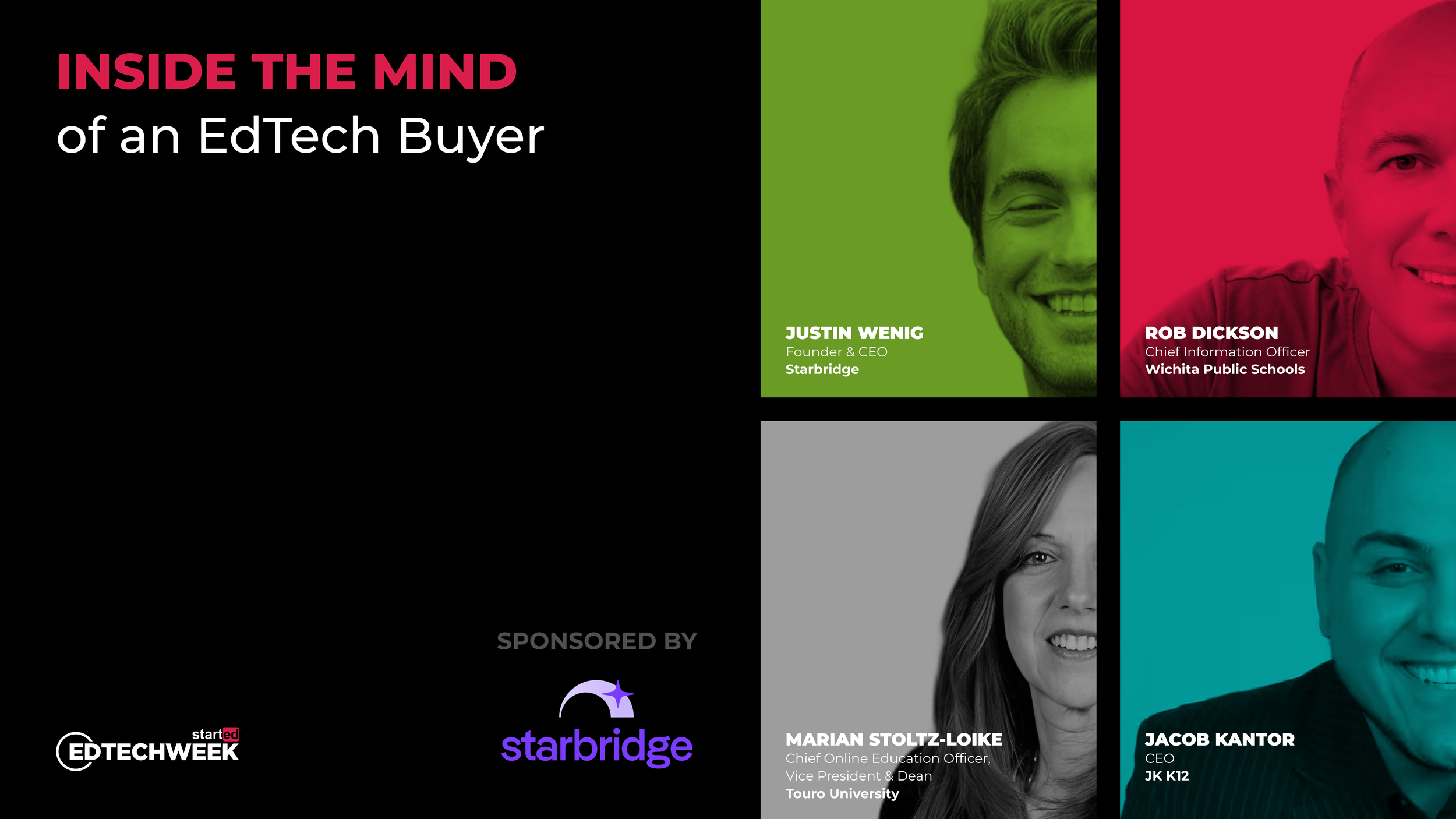
How do school districts and higher ed institutions really buy tech? EdTech sales cycles can feel slow and opaque—but they don’t have to. Join us for an inside look at how institutions evaluate vendors, prioritize investments, and navigate procurement hurdles.
This session explores how leaders assess and select vendors, common friction points in the buying experience, and practical ways to build stronger public–private relationships. You’ll learn how institutions shortlist partners, overcome procurement barriers, and build trust-based partnerships that drive adoption and renewals.
-
Summary
The core theme of the session is that the "COVID cash flush" era of EdTech is over. Buyers are no longer scrambling to buy devices or software just to keep the lights on. Instead, institutions are tightening budgets and looking for strategic partners rather than transactional vendors.
Success in the current market requires a shift from "solution looking for a problem" to a "problem of practice" approach. Buyers are prioritizing long-term relationships, implementation fidelity, and products that offer convergence—solving multiple problems with a single solution.
Key Insights1. The "Seesaw Moment" in Funding During the pandemic, schools had an influx of funding to try everything. Now, money is out of the system. This means sales cycles are longer, and vendors must act as "farmers" planting seeds for future relationships rather than hunters looking for quick wins. If a relationship is not established, the vendor must provide a rigorous model for implementation fidelity to justify the spend to school boards.
2. Hyper-Personalization is the New Standard Generic outreach is dead. Because AI tools allow anyone to send thousands of emails, the bar for human connection has risen. Buyers expect vendors to know:
The Institution: Understand their strategic plan, specific challenges, and poverty levels.
The Individual: Know their recent podcast appearances, career history, or articles they’ve written.
The Context: Don't ask basic questions that could be answered via a Google search.
3. K-12 vs. Higher Ed: Different Worlds Vendors often make the mistake of treating all education buyers the same.
K-12 (District): Decisions are often centralized. If a CIO like Rob Dickson buys a product, the whole district adopts it.
Higher Ed: Decisions are decentralized. A purchase by one college (e.g., Undergraduate) does not mean adoption by the Graduate or Medical schools within the same university system.
4. The "Green Flags" of Trust Trust is the currency of the current market. "Green flags" that lower a buyer's guard include:
Existing Partners: partnering with a vendor the district already trusts.
Referenceable Clients: Bringing examples from districts of similar size and demographics.
Honesty: Being upfront about what the product cannot do yet.
Practical TipsFor Your Outreach
Stop the Cold Call Spam: Endless emails and calls are a "death knell" that causes buyers to tune you out.
Use "Volume x Personalization": You can use AI to help, but you must do the "human homework." Reference specific details (e.g., "I heard you on the CoSN podcast talking about teacher retention") to build instant rapport.
Make it Shareable: Send short (3-4 minute) video overviews that a champion can easily share with other decision-makers internally.
For the Meeting
Don’t Demo Immediately: Jumping straight into a pitch without understanding the district’s specific landscape is a major mistake. Spend the first part of the call building a relationship and understanding their problems.
Bring the Right Team: If selling to a university, bring experts who speak "Higher Ed" language. If you can't answer a technical question, don't fake it—bring the technical team next time.
Show, Don't Just Tell: Use case studies. A story about how a similar district solved a specific problem is more powerful than a feature list.
For Closing & Implementation
Define "Success" in Pilots: Since money is tight, pilots are critical. However, you must agree on what success looks like and how it will be measured before the pilot begins.
Address AI & Data Privacy First: Buyers are wary of AI. Be proactive about explaining how you handle data security and privacy. If you cannot guarantee data safety, you may lose the contract regardless of how good the tool is.
Human in the Loop: When selling AI tools, emphasize that the human (teacher/admin) retains judgment and control. Schools do not want AI making final decisions on students.
One Final Takeaway: If a buyer cannot understand what your product solves within two minutes, the pitch is a fail. Keep it simple, relevant, and focused on their problems, not your features.