
Education Policy & District Leadership
The Policy Makers Track at EdTech Week features leaders shaping the future of education systems, including district administrators, government officials, and policy experts.
These sessions explore how large school systems adopt technology, how policy influences innovation in education, and how collaboration between educators, founders, and investors drives change across the sector.
Whether you're a founder building in education, an investor tracking the market, or an educator interested in system-level innovation, these conversations provide an inside look at how decisions are made at scale.

What happens when the nation’s largest school system meets a leading changemaker at the intersection of AI, equity, and education?
In this conversation, former NYC Public Schools Chancellor Melissa Aviles-Ramos and activist-entrepreneur Colin Kaepernick discuss how AI can advance achievement and empower students. From improving reading instruction to amplifying student voice, the session explores both the promise and responsibility of serving nearly one million learners. They’ll examine how NYCPS is piloting AI, the vision behind Kaepernick’s platform Lumi, and how AI can support teachers and strengthen student identity.
-
Summary
This session brought together the leader of the nation’s largest school district and the founder of the AI-driven storytelling platform, Lumi, to discuss how Artificial Intelligence can serve as a catalyst for student empowerment rather than a replacement for traditional education.
Key Insights1. The Missed Opportunity of Post-COVID Education Chancellor Aviles-Ramos noted that while there are pockets of innovation, the U.S. largely missed the chance to systemically redesign schools after the pandemic. Most classrooms returned to students sitting in rows with teachers talking at them. The vision for an AI-powered future involves moving away from this model toward experiential learning where students demonstrate mastery through authentic community engagement rather than just paper tests.
2. AI as a Tool for Personalization and Agency A major theme of the discussion was using AI to meet students where they are.
Differentiation: Teachers often face classes with students ranging from 4th-grade to 11th-grade reading levels; AI can help personalize content to bridge these gaps.
Student Agency: Kaepernick emphasized that when students are given agency to drive the creative process, engagement skyrockets. He cited examples of students using AI to create narratives that processed deep personal trauma—such as bullying or the loss of a parent—while still meeting rigorous academic standards in English and Biology.
Real-time Intervention: Instead of waiting for lagging indicators like test scores, AI tools can assess literacy and surface intervention opportunities in real-time.
3. Empowering, Not Replacing, the Teacher Both speakers addressed the fear that AI will replace educators. The Chancellor argued that the deep, life-altering relationships teachers build with students cannot be automated. instead, the goal is to use AI to handle the "drudgery"—logistics, compliance, and grading—so teachers are freed up to focus on mentoring and instruction.
4. Equity, Access, and the "Digital Divide" The discussion framed AI as a potential "ultimate equalizer".
Resource Access: AI can provide high-quality tutoring and college advising to students whose parents cannot afford private services.
Language Justice: Kaepernick highlighted how AI tools allow students to create content in their native languages (e.g., Spanish, Japanese, Turkish) and translate it, ensuring that language barriers do not become knowledge barriers.
Cultural Responsiveness: NYC’s framework prioritizes tools that mitigate bias and celebrate diversity, ensuring content is culturally relevant to the student body.
5. The Risk of Inaction Perhaps the most urgent insight was that the biggest risk regarding AI is not the technology itself, but the failure to act. Kaepernick warned that we are facing a moment similar to the digital divide: communities will either close gaps exponentially or fall drastically behind. With 75% of employers already looking for AI skills, failing to prepare students for this reality is a disservice to their future.
Practical Tips
Based on the frameworks and experiences shared by Aviles-Ramos and Kaepernick, here are practical steps for implementing AI in schools:
For School Leaders and Administrators:
Implement a Safety Framework: NYC utilizes a four-part framework: 1) Ensure guardrails and data privacy, 2) Prepare students for AI careers, 3) Mitigate bias in tools, and 4) Support educators with administrative tasks.
Prioritize Visibility: When adopting new tools, ensure there is no "black box." Administrators and teachers should have visibility into the prompts and engagements students have with the AI to ensure safety and appropriateness.
Involve Stakeholders Early: Don't just hand down ed-tech mandates. Build with partners, teachers, and students to ensure the tools actually meet their specific needs.
For Teachers:
Shift to a Learning Mindset: You do not need to be an expert immediately. Adopt a growth mindset, experiment with the tools, and see what works for your specific classroom.
Leverage Student Passion: Use AI to allow students to connect curriculum to their personal interests. For example, explaining financial literacy concepts (like stocks) through the context of things they already care about (like sneakers).
Focus on Relationships: Use the time saved by AI tools to double down on the human element—mentoring and emotional support—which technology cannot replicate.
For Ed-Tech Entrepreneurs:
Solve for the Whole District: Don't just focus on a niche outcome. successful tools must account for the needs of students, teachers, administrators, and parents simultaneously.
Make it "Loveable": It is not enough to meet state standards; the tool must be engaging. If students don't like using it, they won't learn from it.
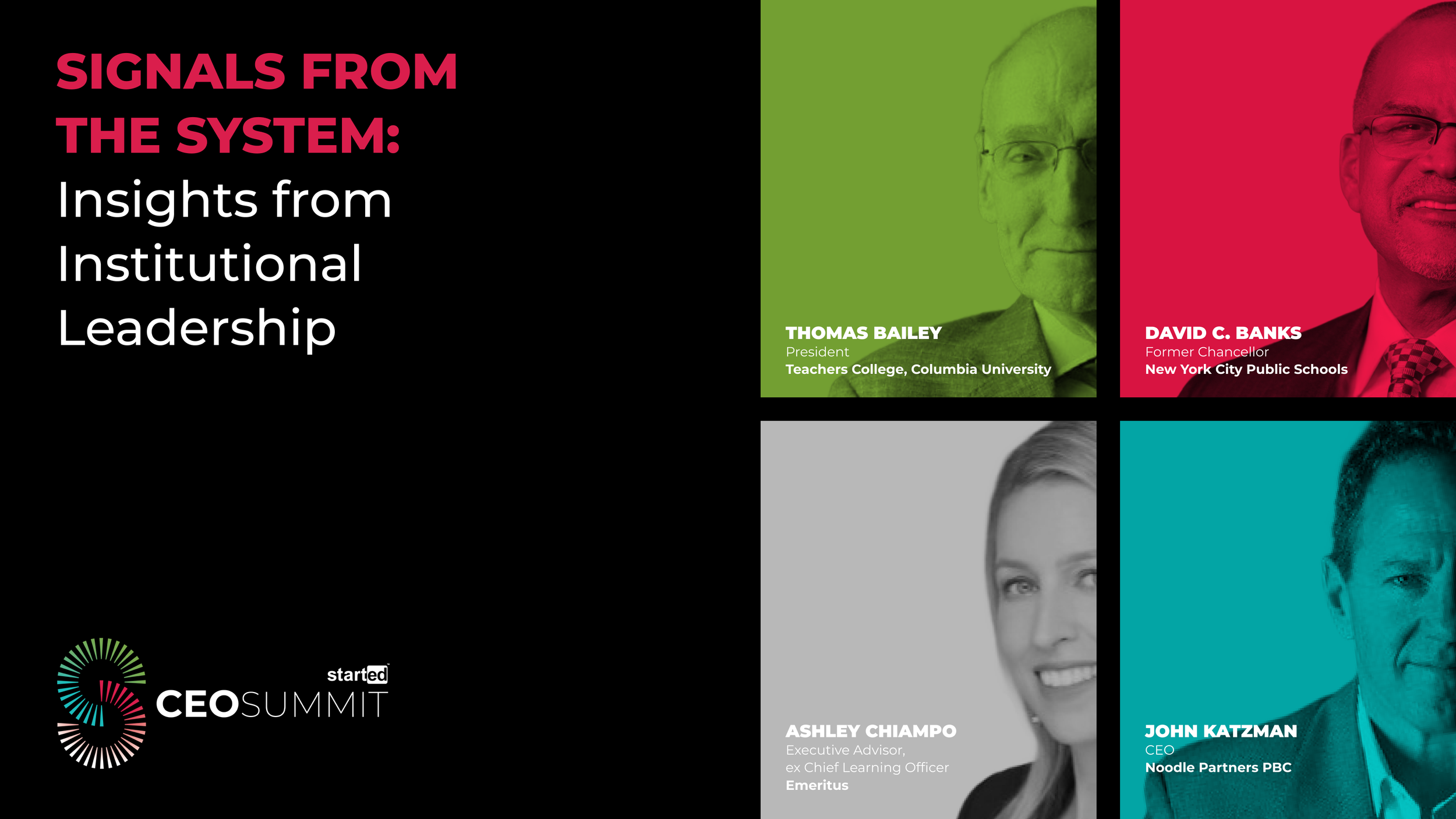
What signals do institutions send when they’re ready to adopt innovation—and how can EdTech leaders listen better? In this rare dialogue, a room of the most influential voices in education leadership share how they evaluate new ideas, balance innovation with accountability, and choose partners that align with system-wide priorities.
From district-scale decision-making to postsecondary transformation, this session reveals how leadership teams weigh risk, evidence, and equity—and what innovators need to understand to build meaningful, durable relationships.
-
Summary
The "Missing Link" in Lifelong Learning The session opened with a stark realization: while the lifelong learning market is valued at approximately $100 billion and growing, higher education institutions hold only about a 1% market share. This is despite universities possessing trusted brands, deep content expertise, and superior pedagogical skills compared to many alternative credential providers. The panel framed this as a massive missed opportunity for higher education to expand its reach and impact.
Breaking the Isolation Between K-12 and Higher Ed A central theme was the historical "isolation" between university schools of education and the K-12 districts they serve.
The Alignment Mandate: David Banks highlighted that school systems can no longer afford to hire teachers unprepared for district-wide strategies. He cited the "NYC Reads" initiative, noting that he informed higher education leaders that if they did not teach the "science of reading," the city would simply not hire their graduates.
System vs. Collection of Schools: Banks argued that to move from having "great schools" to being a "system of great schools," districts must connect the dots between higher ed partners, community organizations, and parents, ensuring a standardized, high-quality approach across the board.
The AI Revolution: Assessment, Feedback, and Roles The panelists agreed that AI is not just a tool for efficiency, but a mechanism to fundamentally change learning outcomes.
The Death of the Traditional Essay: Tom Bailey noted that AI challenges 200-year-old assessment methods like the essay. If an AI can write the report, educators must pivot to teaching and assessing the underlying thinking and research processes rather than the final written product.
Immediate Feedback: Ashley Campo emphasized that AI allows for "instant feedback and practice" at scale—something previously impossible. This allows students to go through the learning cycle multiple times in a single sitting rather than waiting weeks for a professor's grade.
Solving the Personnel Gap: Banks pointed out that AI offers a solution to the chronic shortage of guidance and career counselors in K-12 schools. AI can democratize access to college and career advice for students who currently receive little to no support.
The Enduring Value of Liberal Arts Despite the push for technical skills, the panel defended the long-term economic and social value of a liberal arts education.
Adaptability Over Obsolescence: Bailey warned against the "coding bootcamp" mentality, noting that specific technical skills (like coding) can become obsolete quickly. In contrast, liberal arts education fosters adaptability and social interaction—skills necessary to survive in a world where technology changes every five years.
AI Literacy as a Liberal Art: Banks added that even liberal arts majors must embrace AI. Success in the future workforce will depend on the critical thinking required to "prompt" AI effectively.
Practical TipsBased on the insights shared by the panelists, here are actionable takeaways for stakeholders in the education ecosystem:
For EdTech Companies
Target the "Counseling Desert": There is a massive, specific opportunity to build AI tools that function as college and career counselors for K-12 students, filling a gap that human staffing cannot currently meet.
Focus on Authentic Assessment: Move beyond digitizing multiple-choice exams. Build systems that ingest homework, quizzes, and writing samples to provide a holistic, real-time picture of student progress.
Support the "Edges" of the Classroom: Design AI specifically to help teachers manage the diverse range of learners—providing enrichment for accelerated students and remediation for those struggling—so the teacher isn't forced to only teach to the middle.
For Higher Education Leaders
Align with District "Customers": Do not develop teacher preparation curricula in a vacuum. Actively partner with local school districts to ensure your graduates are trained in the specific pedagogies (e.g., science of reading) the districts are implementing.
Re-evaluate Learning Outcomes: Audit your syllabus. If an assignment can be easily completed by ChatGPT, ask what learning outcome you are actually trying to measure (e.g., critical thinking, research). Redesign the assessment to measure the process, not just the output.
Teach "Durable" Skills: In an era of rapid technological obsolescence, double down on teaching adaptability, collaboration, and complex problem-solving. These are the skills that prevent graduates from becoming obsolete.
For K-12 Leadership
Shift the Teacher's Role: Encourage a shift where teachers become "orchestrators" of social learning and collaboration, while leveraging AI for rote skill-building and immediate feedback.
Prioritize Mental Health: As AI and screens become more prevalent, remain vigilant about the "isolation" effect. Ensure schools remain places of social connection and community building, potentially by limiting phone use or emphasizing team-based work.
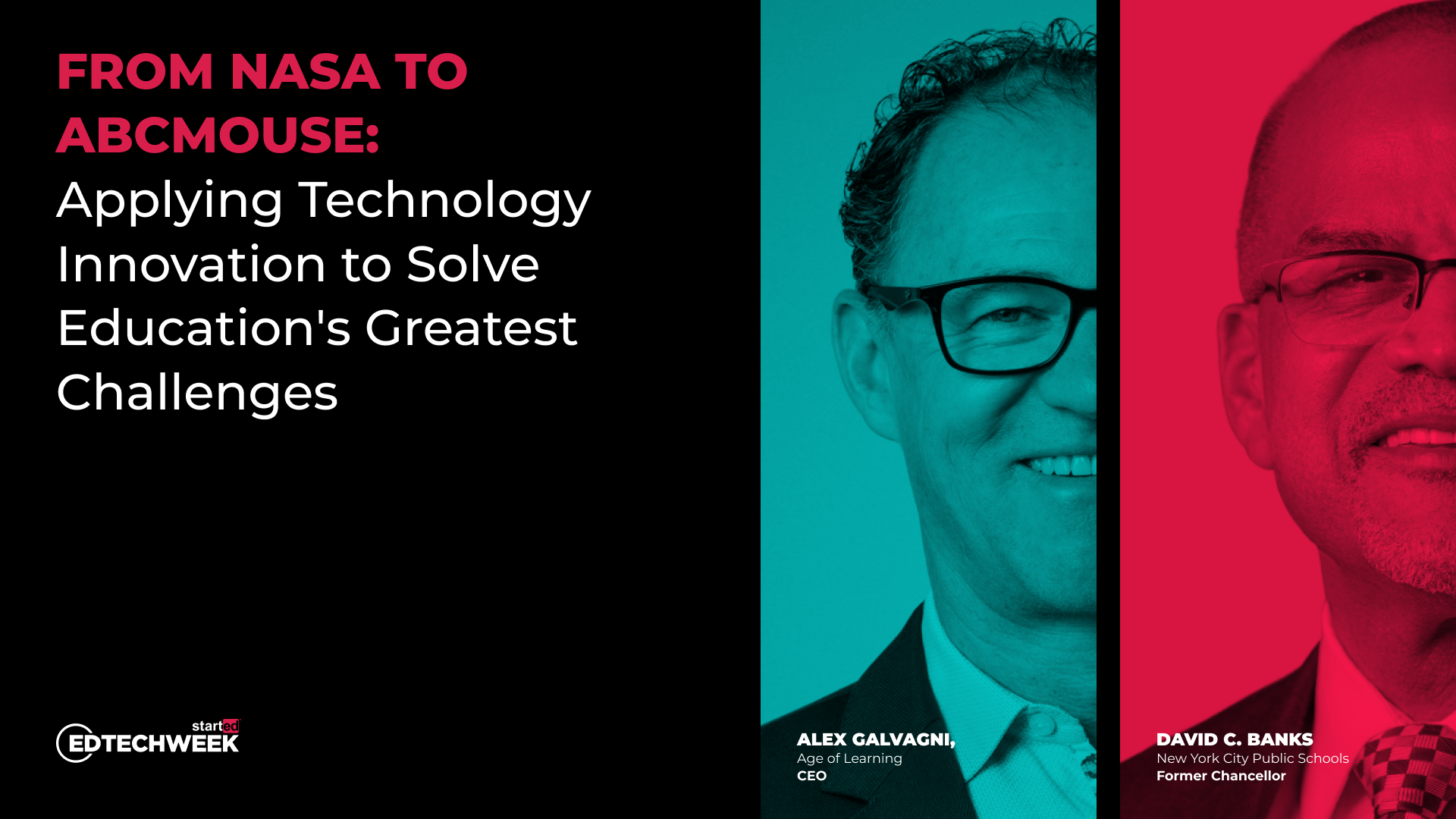
What happens when a NASA-trained technologist takes on education’s biggest problems?
This is a rare look inside the speaker's journey from building AI systems at NASA to leading the team behind ABCmouse and other groundbreaking learning platforms. In this fireside chat, Galvagni will share how his background in advanced technology is shaping scalable, effective, and engaging solutions that meet learners where they are—and move them forward.
This session offers powerful lessons on how cutting-edge innovation, when rooted in educational purpose, can transform learning outcomes at scale.
-
Summary
This session featured a conversation between David C. Banks, former Chancellor of New York City Public Schools, and Alex Galvani, CEO of Age of Learning (creators of ABCmouse). The discussion explored how Galvani’s background in NASA robotics and mobile gaming informs his approach to EdTech. The central theme was leveraging Artificial Intelligence (AI) not to replace educators, but to scale personalized learning, close equity gaps, and foster a lifelong love of learning.
Key Insights1. AI as a Guide, Not a Chatbot While many companies are rushing to create chatbots, Age of Learning utilizes Large Language Models (LLMs) to create a "Mastery AI Assistant".
Personalized Pacing: Instead of a static curriculum, the AI identifies exactly where a child is struggling and provides specific content to keep them in their "zone of proximal development".
Safety and Efficacy: Galvani emphasized that their tools are not chatbots that might hallucinate. Instead, the AI guides students through vetted activities, ensuring accuracy while adapting to the student's pace.
2. The Power of Gamification Galvani drew upon his experience in the mobile gaming industry to highlight that engagement is the prerequisite for learning.
High Engagement: Children using these tools often feel like they are playing a game rather than studying, which leads to significantly higher usage rates compared to standard EdTech software.
Non-Punitive Design: A core "guardrail" for the company is ensuring content is never punitive. Children do not lose points or face negative consequences for mistakes, which preserves their confidence and enjoyment.
3. Innovation promoting Equity and Access Technology is being used to expand reach rather than restrict it to wealthy families.
Global and Local Access: Through AI-driven voiceovers and translations, ABCmouse is now reaching children in countries like Pakistan and Peru. Domestically, the product is free in over 100,000 classrooms and public libraries.
Freemium Models: A new version of ABCmouse includes a "basic mode" that is completely free for families who cannot afford a subscription, ensuring financial barriers do not prevent access to foundational learning.
4. Superpowering Teachers The speakers addressed the fear that AI might replace educators. Galvani argued that AI increases productivity rather than eliminating roles.
Differentiation: One of a teacher's hardest tasks is managing a classroom of students with vastly different skill levels. The software handles this personalization automatically.
Offline Support: The system can generate offline lesson plans specific to a student’s needs, giving teachers actionable tools to use away from the screen.
Practical TipsFor EdTech Leaders and Developers
Obsess Over the Mission: Successful organizations obsess over their core goal—whether it is customer service (Amazon) or information (Google). For education companies, the obsession must be on "reach and impact".
Build Diverse Teams: Drawing on his NASA experience, Galvani recommends building teams that value diversity of thought, including a mix of PhDs and self-taught programmers, within a flat meritocracy.
Iterate Constantly: Just as NASA constantly improved space shuttle docking solutions, EdTech requires a mentality of constant iteration to improve safety and efficacy.
For Educators and Administrators
Embrace AI for Productivity: View AI as a tool to handle time-consuming tasks like differentiation and lesson planning, allowing you to focus on direct instruction and student relationships.
Focus on Early Foundations: Literacy and a love of learning must be established early (ages 2–8). Interventions at this stage are critical for long-term academic success.
For Parents and Communities
Broaden Career Exposure: Children "will be what they see." Use digital resources to expose children to careers they might not see in their immediate neighborhood. Age of Learning partners with NASA and the MLB to connect math and science to space exploration and baseball.
Look for "Bright Starts": Ensure children have a solid foundation before third grade. Using engaging, non-punitive educational games can help children develop intrinsic motivation and a love for learning.
As classrooms adapt to AI, one truth remains: teachers are irreplaceable. Rita Joseph, lifelong educator and Chair of the NYC Council’s Education Committee, challenges us to ensure AI in schools reflects our shared values—equity, access, and human dignity. Her remarks will bridge the gap between innovation and integrity, calling on educators and leaders to shape the policies that define the next generation of learning.
-
Summary
This session featured a conversation between David C. Banks, former Chancellor of New York City Public Schools, and Alex Galvani, CEO of Age of Learning (creators of ABCmouse). The discussion explored how Galvani’s background in NASA robotics and mobile gaming informs his approach to EdTech. The central theme was leveraging Artificial Intelligence (AI) not to replace educators, but to scale personalized learning, close equity gaps, and foster a lifelong love of learning.
Key Insights1. AI as a Guide, Not a Chatbot While many companies are rushing to create chatbots, Age of Learning utilizes Large Language Models (LLMs) to create a "Mastery AI Assistant".
Personalized Pacing: Instead of a static curriculum, the AI identifies exactly where a child is struggling and provides specific content to keep them in their "zone of proximal development".
Safety and Efficacy: Galvani emphasized that their tools are not chatbots that might hallucinate. Instead, the AI guides students through vetted activities, ensuring accuracy while adapting to the student's pace.
2. The Power of Gamification Galvani drew upon his experience in the mobile gaming industry to highlight that engagement is the prerequisite for learning.
High Engagement: Children using these tools often feel like they are playing a game rather than studying, which leads to significantly higher usage rates compared to standard EdTech software.
Non-Punitive Design: A core "guardrail" for the company is ensuring content is never punitive. Children do not lose points or face negative consequences for mistakes, which preserves their confidence and enjoyment.
3. Innovation promoting Equity and Access Technology is being used to expand reach rather than restrict it to wealthy families.
Global and Local Access: Through AI-driven voiceovers and translations, ABCmouse is now reaching children in countries like Pakistan and Peru. Domestically, the product is free in over 100,000 classrooms and public libraries.
Freemium Models: A new version of ABCmouse includes a "basic mode" that is completely free for families who cannot afford a subscription, ensuring financial barriers do not prevent access to foundational learning.
4. Superpowering Teachers The speakers addressed the fear that AI might replace educators. Galvani argued that AI increases productivity rather than eliminating roles.
Differentiation: One of a teacher's hardest tasks is managing a classroom of students with vastly different skill levels. The software handles this personalization automatically.
Offline Support: The system can generate offline lesson plans specific to a student’s needs, giving teachers actionable tools to use away from the screen.
Practical TipsFor EdTech Leaders and Developers
Obsess Over the Mission: Successful organizations obsess over their core goal—whether it is customer service (Amazon) or information (Google). For education companies, the obsession must be on "reach and impact".
Build Diverse Teams: Drawing on his NASA experience, Galvani recommends building teams that value diversity of thought, including a mix of PhDs and self-taught programmers, within a flat meritocracy.
Iterate Constantly: Just as NASA constantly improved space shuttle docking solutions, EdTech requires a mentality of constant iteration to improve safety and efficacy.
For Educators and Administrators
Embrace AI for Productivity: View AI as a tool to handle time-consuming tasks like differentiation and lesson planning, allowing you to focus on direct instruction and student relationships.
Focus on Early Foundations: Literacy and a love of learning must be established early (ages 2–8). Interventions at this stage are critical for long-term academic success.
For Parents and Communities
Broaden Career Exposure: Children "will be what they see." Use digital resources to expose children to careers they might not see in their immediate neighborhood. Age of Learning partners with NASA and the MLB to connect math and science to space exploration and baseball.
Look for "Bright Starts": Ensure children have a solid foundation before third grade. Using engaging, non-punitive educational games can help children develop intrinsic motivation and a love for learning.
Policy changes are influencing procurement, funding, and institutional priorities—meaning today’s strategies may not work tomorrow. In this session, expert panelists break down key legislative and regulatory developments affecting the edtech market and what they mean for go-to-market teams. Learn how evolving policies—from school choice to AI regulation—are impacting spending trends, sales pipelines, and the strategic adjustments companies must make heading into 2026.
-
Summary
This session featured a conversation between David C. Banks, former Chancellor of New York City Public Schools, and Alex Galvani, CEO of Age of Learning (creators of ABCmouse). The discussion explored how Galvani’s background in NASA robotics and mobile gaming informs his approach to EdTech. The central theme was leveraging Artificial Intelligence (AI) not to replace educators, but to scale personalized learning, close equity gaps, and foster a lifelong love of learning.
Key Insights1. AI as a Guide, Not a Chatbot While many companies are rushing to create chatbots, Age of Learning utilizes Large Language Models (LLMs) to create a "Mastery AI Assistant".
Personalized Pacing: Instead of a static curriculum, the AI identifies exactly where a child is struggling and provides specific content to keep them in their "zone of proximal development".
Safety and Efficacy: Galvani emphasized that their tools are not chatbots that might hallucinate. Instead, the AI guides students through vetted activities, ensuring accuracy while adapting to the student's pace.
2. The Power of Gamification Galvani drew upon his experience in the mobile gaming industry to highlight that engagement is the prerequisite for learning.
High Engagement: Children using these tools often feel like they are playing a game rather than studying, which leads to significantly higher usage rates compared to standard EdTech software.
Non-Punitive Design: A core "guardrail" for the company is ensuring content is never punitive. Children do not lose points or face negative consequences for mistakes, which preserves their confidence and enjoyment.
3. Innovation promoting Equity and Access Technology is being used to expand reach rather than restrict it to wealthy families.
Global and Local Access: Through AI-driven voiceovers and translations, ABCmouse is now reaching children in countries like Pakistan and Peru. Domestically, the product is free in over 100,000 classrooms and public libraries.
Freemium Models: A new version of ABCmouse includes a "basic mode" that is completely free for families who cannot afford a subscription, ensuring financial barriers do not prevent access to foundational learning.
4. Superpowering Teachers The speakers addressed the fear that AI might replace educators. Galvani argued that AI increases productivity rather than eliminating roles.
Differentiation: One of a teacher's hardest tasks is managing a classroom of students with vastly different skill levels. The software handles this personalization automatically.
Offline Support: The system can generate offline lesson plans specific to a student’s needs, giving teachers actionable tools to use away from the screen.
Practical TipsFor EdTech Leaders and Developers
Obsess Over the Mission: Successful organizations obsess over their core goal—whether it is customer service (Amazon) or information (Google). For education companies, the obsession must be on "reach and impact".
Build Diverse Teams: Drawing on his NASA experience, Galvani recommends building teams that value diversity of thought, including a mix of PhDs and self-taught programmers, within a flat meritocracy.
Iterate Constantly: Just as NASA constantly improved space shuttle docking solutions, EdTech requires a mentality of constant iteration to improve safety and efficacy.
For Educators and Administrators
Embrace AI for Productivity: View AI as a tool to handle time-consuming tasks like differentiation and lesson planning, allowing you to focus on direct instruction and student relationships.
Focus on Early Foundations: Literacy and a love of learning must be established early (ages 2–8). Interventions at this stage are critical for long-term academic success.
For Parents and Communities
Broaden Career Exposure: Children "will be what they see." Use digital resources to expose children to careers they might not see in their immediate neighborhood. Age of Learning partners with NASA and the MLB to connect math and science to space exploration and baseball.
Look for "Bright Starts": Ensure children have a solid foundation before third grade. Using engaging, non-punitive educational games can help children develop intrinsic motivation and a love for learning.
When schools face urgent challenges, the most effective R&D leaders redesign the system rather than retreat. This session brings together leaders from AERDF, ALI, and Education First to highlight a new model of education R&D—cross-sector, practice-informed, and built to move bold ideas into classrooms faster. Through real district partnerships, panelists will share lessons on co-design, aligning vision with evidence, and accelerating research into scalable tools. Attendees will gain practical strategies to engage with this emerging ecosystem and drive solutions with rigor, relevance, and equity.
-
Summary
This session featured a conversation between David C. Banks, former Chancellor of New York City Public Schools, and Alex Galvani, CEO of Age of Learning (creators of ABCmouse). The discussion explored how Galvani’s background in NASA robotics and mobile gaming informs his approach to EdTech. The central theme was leveraging Artificial Intelligence (AI) not to replace educators, but to scale personalized learning, close equity gaps, and foster a lifelong love of learning.
Key Insights1. AI as a Guide, Not a Chatbot While many companies are rushing to create chatbots, Age of Learning utilizes Large Language Models (LLMs) to create a "Mastery AI Assistant".
Personalized Pacing: Instead of a static curriculum, the AI identifies exactly where a child is struggling and provides specific content to keep them in their "zone of proximal development".
Safety and Efficacy: Galvani emphasized that their tools are not chatbots that might hallucinate. Instead, the AI guides students through vetted activities, ensuring accuracy while adapting to the student's pace.
2. The Power of Gamification Galvani drew upon his experience in the mobile gaming industry to highlight that engagement is the prerequisite for learning.
High Engagement: Children using these tools often feel like they are playing a game rather than studying, which leads to significantly higher usage rates compared to standard EdTech software.
Non-Punitive Design: A core "guardrail" for the company is ensuring content is never punitive. Children do not lose points or face negative consequences for mistakes, which preserves their confidence and enjoyment.
3. Innovation promoting Equity and Access Technology is being used to expand reach rather than restrict it to wealthy families.
Global and Local Access: Through AI-driven voiceovers and translations, ABCmouse is now reaching children in countries like Pakistan and Peru. Domestically, the product is free in over 100,000 classrooms and public libraries.
Freemium Models: A new version of ABCmouse includes a "basic mode" that is completely free for families who cannot afford a subscription, ensuring financial barriers do not prevent access to foundational learning.
4. Superpowering Teachers The speakers addressed the fear that AI might replace educators. Galvani argued that AI increases productivity rather than eliminating roles.
Differentiation: One of a teacher's hardest tasks is managing a classroom of students with vastly different skill levels. The software handles this personalization automatically.
Offline Support: The system can generate offline lesson plans specific to a student’s needs, giving teachers actionable tools to use away from the screen.
Practical TipsFor EdTech Leaders and Developers
Obsess Over the Mission: Successful organizations obsess over their core goal—whether it is customer service (Amazon) or information (Google). For education companies, the obsession must be on "reach and impact".
Build Diverse Teams: Drawing on his NASA experience, Galvani recommends building teams that value diversity of thought, including a mix of PhDs and self-taught programmers, within a flat meritocracy.
Iterate Constantly: Just as NASA constantly improved space shuttle docking solutions, EdTech requires a mentality of constant iteration to improve safety and efficacy.
For Educators and Administrators
Embrace AI for Productivity: View AI as a tool to handle time-consuming tasks like differentiation and lesson planning, allowing you to focus on direct instruction and student relationships.
Focus on Early Foundations: Literacy and a love of learning must be established early (ages 2–8). Interventions at this stage are critical for long-term academic success.
For Parents and Communities
Broaden Career Exposure: Children "will be what they see." Use digital resources to expose children to careers they might not see in their immediate neighborhood. Age of Learning partners with NASA and the MLB to connect math and science to space exploration and baseball.
Look for "Bright Starts": Ensure children have a solid foundation before third grade. Using engaging, non-punitive educational games can help children develop intrinsic motivation and a love for learning.